The Creativity Leap – Natalie Dixon

Via Seth Godin’s podcast. He called The Creativity Leap “even better” then his own, at that time not yet published book The Practice.

The Creativity Leap

The Creativity Leap is about activating the creative process in individuals and in organizations, and how creativity can transform people and organizations.

Invest in hobbies. Learn new things, cultivating a childlike, open outlook.

Seek out ideas from outside your normal world.

Creative ideas are formed during daydreaming, during doing nothing. On the other hand: practice makes perfect, without a lot of practice there is no mastery.

Learn to ask better questions. Start with “big picture” questions and then descend to specific questions.

Open-source collaboration and informal structures lead to cross-pollination and better solutions.

Research leads to better questions.

Practice improvisation and out-of-the-box thinking.

Have explicit attention to intuition; intuition is also a data point.

Work in communities.

Facilitate hybrid thinking; combine tech and artistic thinking, analog and digital.

Reuse, remix what is already there.

Make things within the constraints that are there. Creativity works best within constraints.

Get out of your brain. Look at yourself and things from a different angle. Get messy. Combine deep specialization with broad experience. Combine rationality with ambiguity. Combine a tight organization with a loose network organization.

Drift.

Unreasonable Success and How To Achieve It – Richard Koch

I think it was Tim Ferriss’ podcast episode with Richard Koch that put me on Richard Koch’s trail. First I read The 80/20 Principle, then bought Unreasonabe Success.

In the book, Koch describes the wisdom he has extracted from the lives of amazing people such as Nelson Mandela, Bob Dylan, Winston Churchill, Jeff Bezos, Albert Einstein, Victor Frankl, Leonardo Da Vinci, and others. Including, of course, Bill Bain and Bruce Henderson. Who. Bill Bain and Bruce Henderson, former Koch bosses at Bain and company and BCG, respectively. Of course, it is totally out of place in this list, but let’s just say this is Koch’s tribute to his former work

From the lives of the greats, Koch has identified 9 milestones on the road to success. These landmarks form the backbone of this book. Koch describes the landmarks and illustrates them in a highly entertaining way with stories about the greats of this world.

These are the landmarks that Koch identifies.

Self-belief. The courage to get started. Related to self-doubt. Self-doubt strengthens self-confidence.

Olympic expectations. Think big, think huge. Set expectations much higher than normal. Visualize that you are a great achiever, making success much more likely.

Transforming experiences. Learn unusual things from unusual experiences. The conventional path will not lead to unreasonable success. Special experiences do. Develop these experiences.

Breakthrough achievements are mostly innovative, sometimes strategic achievements. Combine extreme determination with extreme flexibility. Be innovative and laughably ambitious, and your ideas come from the soul.

Make your own trail, create your own segment, Invent a new field, narrow that field, and develop a unique philosophy.
Find and drive your personal vehicle. Jump on a major current and stand out. Or create your own vehicle. We would call this a platform these days, I guess.

Thrive on setbacks. Be anti-fragile. Find risks and actions. No actions, no learning, no improvement. Reframe disasters and setbacks.

Acquire unique intuition. Intuition is unique when it is important, original, unproven, imaginative, and based on deep knowledge. Where is your opinion that most others disagree with? (forgot who said that – was it Peter Thiel?)

Distort reality. Apply extreme optimism and determination. Inspire others.

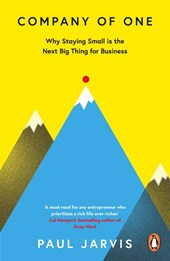
Company of One – Paul Jarvis

Some quick notes on the book Company of One by Paul Jarvis.

Company of One

Book is about staying small in business, and keep having fun doing it. It stead of growing to a monstrous bureaucratic organization, driven by shareholder value.

Companies of one have a clear sense of purpose, are more flexible, can change quickly, can give employees more autonomy and can have more focus.

Make customer relationships more important than customer growth (numbers).

Passion is overrated. Is a side effect of mastery, not the other way around.

Quirky product are not a problem. It distinguishes and provides focus.

More focus on customer success.

Teach everything you know.

Give away ideas.

Trust by proxy – referrals.

Launch quickly, and often.

Build a community.

Rereading, and Derek Sivers’ Hell Yeah or No

Halfway through December, I received my signed copy of Hell Yeah Or No. A good motive to re-read the book.

Derek Sivers - Hell Yeah or No - book cover

I had already read the ebook. I purchased the same offer: an ebook and a signed paper copy. Given the work Derek has put into producing and distributing the signed hardcover version, I cannot imagine he made much money on it.

I seldomly re-read books. But this one is definitely in the re-reading category. As a sidenote, my re-reading category includes: Gerrit Krol (Dutch writer (probably one of the first people writing on Artificial Intelligence in De Man Achter Het Raam (1982!), definitely in the Netherlands, but probably also internationally), Douglas Coupland, Haruki Murakami, Tom Peters (not everything, but definitely The Little Big Things).

Kim Gordon — Girl in a Band: Sonic Youth van binnenuit

Boekcover Girl in a Band van Kim Gordon met oranje achtergrond

Ergens op het internet vond ik een negatieve recensie van Girl in a Band van Kim Gordon. Ik kende het boek niet. De recensent was teleurgesteld. Toch kocht ik het boek, als langjarige liefhebber van Sonic Youth en nieuwsgierig naar Kim Gordon’s leven.

Ik vond het boek zeer goed. Gordon beschrijft haar omgeving met mooie details: huishoudelijke dingen, spullen, muziek. Geschreven in een losse stijl. De pocket editie die ik heb, die met de oranje kaft, is een beetje grungy. Past goed bij de zwart-wit foto’s in het boek.

Kim Gordon schetst een vermakelijk en informatief beeld van het punk-rock leven in de jaren 80, 90 en 00. New York, CBGB, de underground scene, Thurston Moore, bandleden die komen en gaan. Er lijkt geen einde te komen aan de vooruitgang van Sonic Youth.

Tot Thurston Moore een affaire begint met Eva Prinz (de naam staat niet in het boek, maar was met weinig research te achterhalen).

De toon verschuift van melancholisch — in de beschrijving van haar schizofrene broer — naar gedesillussioneerd in haar huwelijk met Thurston Moore. Gordon beschrijft de ineenstorting van een relatie zonder overdreven dramatiek. Juist dat maakt het pijnlijk om te lezen.

Wat Girl in a Band voor mij een goed boek maakt is dat Gordon niet schrijft als rockster. Ze schrijft als iemand die toevallig in een band zat. Haar observaties over kunst, mode en de New Yorkse scene zijn vaak scherper dan die over muziek zelf.

Het is geen “hoe we groot werden” verhaal. Het is een verhaal over volhouden in een wereld die vrouwen in rock niet serieus neemt. Over een broer die wegzakt in schizofrenie. Over een huwelijk dat uitvalt.

Mooi boek, vreemde vrouw.

Meer boekrecensies.
Meer over muziek.