Verwarde Cavia observeert veranderingen
de verwarde cavia cover - paulien cornelisse

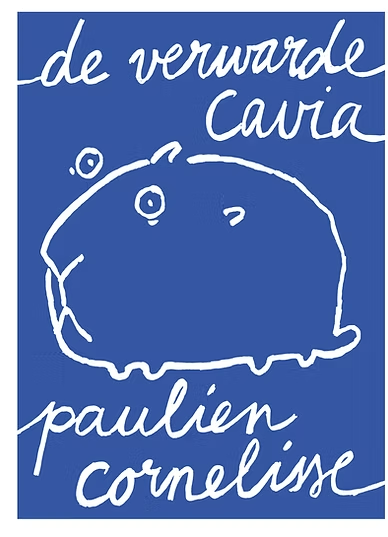
Na Taal Is Zegt Maar Echt mijn Ding, las ik van Paulien Cornelisse De Verwarde Cavia.

De Verwarde Cavia is een melige verzameling columns die eerder in NRC verschenen over de dagelijkse beslommeringen van Cavia, een gescheiden alleenstaande vrouw zonder kinderen. En Cavia observeert. Cavia is het liefst op zichzelf.   Cavia worstelt niet met het leven, hoewel ze wat zeikerig is. Maar het leven overkomt haar. Ze is naïef en neemt heel weinig hele kleine initiatieven. Ze is de goedheid zelve. Ze wordt misbruikt voor dubieuze praktijken als bespioneren van collega’s.

 Het oppervlakkige leven en gebrek aan diepgang is wellicht het thema in de Cavia verhalen.

taal is zeg maar echt mijn ding van paulien cornelisse

Cavia produceert geen diepzinnige gedachten.   En zo kwam het dat Cavia zich te midden van borrelende mensen bezighield met de filosofische vraag: Als je aan het mingelen bent, maar niemand merkt het, is er dan sprake van mingelen? Cavia mijdt moeilijkheden. Maar is droogkomisch.  

Nu Enzo weg was, werd Cavia ineens weer wakker in haar eigen huis. Ze was er de afgelopen tijd zo weinig geweest dat ze het zielig vond voor haar spulletjes, maar ze sprak zichzelf meteen streng toe: Dingen zijn niet zielig! Je kon wel aan de gang blijven. “Het was even stil. ‘En dat jij dan de keynote doet?’ vroeg De Groot.’Bijvoorbeeld!’ zei Cavia. ‘Bijvoorbeeld.’ Zo direct even opzoeken wat precies de definitie van een keynote was. “Goed: zei De Groot. ‘Make it happen.’ Cavia slikte. Cavia raakt in de war van veranderingen. Maar niet op een pathologische manier.   In mineur over alle veranderingen liep Cavia door de regen naar huis. Om zichzelf op te vrolijken kocht ze bij de kantoorboekhandel wat bruine enveloppen, eigenlijk alleen om eraan te ruiken.

Uiteindelijk is het leven van een kantoorbediende die slappe nieuwsbrieven rondstuurt slechts een setting een lichte levenswijze die Paulien Cornelisse voor ons schetst. Het kleine leven in The Office, Het Bureau, Debiteuren Crediteuren, maar dan stiekem toch best gelukkig mee kunnen zijn met de geborgenheid van deze weinig uitdagende werkomgeving.  

Alain De Botton – The Consolations of Philosophy

In The Consolations of Philosophy, Alain de Botton helps us put life’s difficulties into perspective. De Botton guides us through the works of a number of well-known philosophers (Socrates, Epicurus, Seneca, Montaigne, Schopenhauer, Nietzsche) and distills lessons from their work.

From Socrates we learn to examine the statements of self-confident people. Oftentimes you find these statements can not stand up to even mild scrutiny. So, subject their convictions and also your own premises to criticism. Support your beliefs with good answers to counter arguments.

Epicurus tells us that epicurean is actually not, as opposed what we often associate it with today, equivalent to being an unbounded bon-vivant. Instead, Epicurus tells which components are more important than “stuff” for our well-being: friendship, freedom, reflection.

Seneca learns us to enjoy the beautiful things of life, but to always be prepared to loose these acquirements. And to not get freaked out when this happens.

Do not assume the world is conspiring against you. Annoying things happen to you while no one is aiming to hurt you. You are not being sabotaged.
(Even better, to speak with Kevin Kelly, the world is conspiring to your success: pronoia.)

Motaigne states that he who thinks he is wise, is in fact a fool.

The banal physical things can not be denied. Even the king has to shit and it stinks too.

Our culture is not the norm. Our habits and rituals are just as strange as those from a distant Indian tribe in the jungle of South America. Arrogance is misplaced.

Wisdom and scholarship are different things. Wisdom is rarely taught in schools. Not (just) philosophers are able to lead a virtuous life. Also a poorly-educated worker can live wisely and “produce” wisdom. (Grandmothers wisdom).

Schopenhauer strikes me as a grumpy man. It is not our intelligence that steers our decisions, but the unconscious. Our intelligence is busy justifying our decisions through the construction of logical reasonings. Very much like Kahneman has found: fast decision making is done by our System 1 thinking, which is impulsive and subjective. Our System 2 is more thoughtful and slow, but tends not to correct System 1 decisions but rather justify those decisions.

Love between man and woman is only successful if our unconscious thinks that it may produce good offspring. Procreation is what drives all this, unconsciously. Consoling consequences: when your love is declined, this is only because nature predicts an unsuccessful reproduction, not so much because the other person dislikes you.

Nietzsche explains there is no joy without difficulties. Difficulties are necessary prerequisites for joy.

From the efforts of the craftsman follows the genius of the artist. Genius is not born but created. The route to follow learning your crafts: sublimate, spiritualize (internalize), elevate. Do not resign to things that are too difficult to achieve, but instead fight to achieve these. There is no other way.

See also Beauty and Consolation.

Derek Sivers’ Hell Yeah or No: a collection of counterpoints

Get on on Derek Sivers‘ great mailing list. Last week through this list he offered me the opportunity to buy his accidentally published book

Derek Sivers

Hell Yeah or No“. I took the bait.

The saying “Hell Yeah or No” has become one of Derek’s more famous expressions, originating from the book Anything You Want.

The book Hell Yeah or No is a collection and rework of a number of Derek’s blog posts.One chapter in the book describes best what Derek is about.

My public writing is a counterpoint meant to complement the popular point.

Many articles in the book make you think “Mmm… yeah – that’s a good point of view too”.

A couple of week ago I purchased his other new book Your Music and People. Did not find room to read it yet. But expectations are up. 

Leonardo Da Vinci by Walter Isaacson

The world was too big, even for the huge talents of Leonardo Da Vinco Walter Isaacson wrote a biography of one of the world’s biggest geniuses. 

Da Vinci was a strange guy. He was extremely curious. So curious, that he hard a hard time finishing things. Always on the way to the next thing, and many other things at the same time. 

He didn’t make things easy for himself. He was interested in so many things: painting, drawing, sculpture, engineering, science, urban design, biology, anatomy, physics. The list goes on. 

What also did not help him was his perfectionism. If it couldn’t be perfect, he lost interest, or kept on improving forever. The Mona Lisa was a life-time’s work. He carried it around for decades, constantly improving it. A huge wall fresco in Florence, The Battle of Anghiari, he abandoned because he could not produce it the way he wanted. The invention was more important to him than the execution, improving more important than delivering. He had many book ideas, but finished none. 

But this immense breadth of interests and his doggedness is also the core of his genius. He invented things that others could not see. He combined knowledge that was not combined before. He approached art with a scientific approach. He made anatomic drawings with artistic quality. He wanted to know everything about anything. Isaacsons calls him the personification of the universal mind.

In the last chapter Isaacson lists the lesson we can learn from Da Vinci’s life. (Da Vinci was a keen list-maker himself.)

Be curious, relentlessly curious.

Seek knowledge for its own sake.

Retain a childlike sense of wonder.

Observe.

Start with the details.

See things unseen.

Go down rabbit holes.

Get distracted.

Respect facts.

Procrastinate.

Let the perfect be the enemy of the good.

Think visually.

Avoid silos.

Let your reach exceed your grasp.

Indulge fantasy.

Create for yourself, not just for patrons.

Collaborate.

Make lists.

Take notes, on paper.

Be open to mystery.

A good article that summarizes the lessons, is this: https://www.saturdayeveningpost.com/2018/05/20-life-lessons-leonardo-da-vinci/

Some of these lessons, when applied undisciplined (like Da Vinci), can lead to the perfectionism and chronic inability to ship we have seen in Leonardo’s life. Despite his extreme talents, the world was too big, even for Leonardo Da Vinci.