Tim Robinson’s joy for precision

Tim Robinson’s books are amazingly interesting precise works of litarature. He has created a new genre of literature, a landscape biography.

With meticulous labor, Robinson in the two books Stones of Aran: Pilgrimage and Stones of Aran: Labyrinth tells us about the history of the islands. He does this while describing his systematic hikes across the Aran Islands, painting a detailed view of the barren island.

The small Aran Islands are presented meter by meter, crag by crag, fissure by fissure.
As a mapmaker he records every limestone rock, house, barn, wall. But he also talks to the farmers. He talks about the isolation of the islanders. Their strange habits. Their faith. Their own Saint Enda of Aran. Their history.

The people of Aran were extremely poor and permanently threatened by famine. On their small rock island on the edge of the Atlantic Ocean, they made a living by fishing, harvesting burning seaweed to sell the kelp (which contained iodine and alkali), and growing potatoes on their fissured rocky field fertilized with seaweed.

“Large families live of the bounties of a few small plots, and save all other income for the rent; the potato thrived on the plenteous labour of those families, the carting of sand and seaweed that created the plots out of rock, the spadework that doubled the shallow soil into ridges, the weeding and watering could be done by children. Fecundity led to overcrowding: the ridges full of low-quality potatoes vulnerable to drought, pests, diseases and prolonged salty winds that scorched their stems…” (Labyrinth)

“The Aranners distinguish about thirty types of seaweed, each with its own advantages and disadvantages as fertilizer, for various crops or as raw materials of kelp. The main division is between feamainn dhubh, blacked and feamainn dhearg, redwood. The former comprises the dark-toned Focus species that grow on the upper and middle shore, …” (Pilgrimage)

They hunt for basking sharks in wobbly boats, called currachs, made of lath and canvas …

“All available tackle – ‘spears, gaffs, bocáns, pocáns, buoys, boreógs, straimpíns, one knives and poles and chains taken from a ship wrecked at Big Cleft’ – was assembled and carried down to Port Bhéal and Dúin; a spear was attached by a rope and a cable to a chain wound around a big boulder in a depp pot-hole of the shore; five three-men in currachs were launched, a shark was eventually speared, and when it had run itself to exhaustion another team of fitted men hauled it ashore.” (Pilgrimage)

And go on life-endangering searches high on the cliffs for eggs and birds.

“Razor bills, guillemots, and black guillemots, puffins and cormorants were the birds usually taken on the cliffs. Both eggs and birds were eaten, …

The hunt was conducted as follows. The men would walk across the the cliffs at dusk with the rope, which was often a communal investment. One end of it would be tied around the cliff man’s waist and between his legs, and the other made fast to an iron bar driven into a crevice or wedged in a cairn on the clifftop. A team of up to eight would lower the cliff man, guided by signals from a man stationed out on a headland from which he could watch the progress of the descent. The cliff man would carry a stick to keep himself clear of the cliff face while swinging of the rope…” (Pilgrimage)

A masterpiece of scrupulous investigation. Wonderfully written with massive joy and persistence.
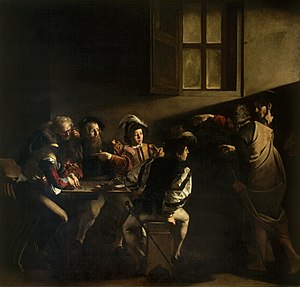
Clair-obscur in San Luigi dei Francesi

De taxi van Fiumicino naar het hotel in Rome kost 50 euro. Dat lijkt een beetje overdreven. Als straf geef ik geen fooi aan de taxichauffeur. Toch geeft hij me zijn visitekaartje en biedt me een korting aan voor de terugreis naar het vliegveld – 35 euro.

Ik ben dus weer een paar uur in het centrum van Rome (na een week vakantie met mijn vrouw in januari).

De metro doorkruist de rommelige buitenwijken van Rome.

Ik stap uit bij Cavour (het metrostation) en dwaal rond.

(Ik ga de Dan Brown thriller niet volgen.)

I krijg honger. Ontbijt in het vliegtuig was licht. Ik koop een sandwich, die ik opeet op weg naar San Pietro in Vincoli.

De kerk gaat om drie uur weer open. Ik ben deze lange lunchpauzes vergeten.

Ik heb geen zin om te wachten en verder te gaan via Via dei Fori Imperiali naar Piazza Novano. Op de Via dei Fori Imperiali vinden massale restauraties plaats om de afbraak 80 jaar geleden ongedaan te maken.

The Calling of Saint Matthew-Caravaggo (1599-1600).jpg

Het is enorm druk in het Pantheon, uiteraard. Snel naar binnen en dan naar San Luigi dei Francesi om de Caravaggios te bekijken. Indrukwekkende schilderijen met dat typische Caravaggio licht, alle drie gewijd aan de profeet Matthew.

Het is vreemd hoe de schilderijen in het donker zijn geplaatst. Wat ik niet wil benadrukken is Caravaggio’s clair-obscur stijl. Nee, het is het geld. Pas nadat een Japanse toerist wat munten in de machine heeft gegooid die de verlichting regelt, kun je de schilderijen een paar minuten bekijken.

Design your future – Taylor Pearson on the end of jobs

Create your own job. the end of jobs

Taylor Pearson tells us in The End of Jobs. And explains how profitable this can be in today’s world.

Jobs as we know them will largely disappear. We are at the end of the Frederick Taylor work era.

Jobs are replaced by entrepreneurs. Everyone can be an entrepreneur, building a meaningful life doing what they want, now serving the long tail of markets has become profitable.

It Will Be Exhilarating Review: Studio Neat’s Bootstrap Story

It Will Be Exhilarating by [Provost, Dan, Gerhardt, Tom]

The creators of the Glif decided to write It Will Be Exhilarating to share their experience building their company Studio Neat. They build their company as lean as possible, bootstrapped it, using low level tools, crowdsourcing and simple concepts.

Indie Capitalism: How Studio Neat Built a Lean Creative Business

Their example was 37Signals, a company raised with a comparable independent approach, whose founders also wrote a book, Reworkread my post on that book here, about their experiences.

The book is describing Indie Capitalism.

Afbeeldingsresultaat voor studio neat the glif

Focus and simplicity are essential. As important as the thing you do, are the things you decide not to do.

Work your ideas:

“Your idea is not doing anyone any good by remaining only an idea.”

Practical tips: create a product video that is brief and clear.

“Our two project videos have been like a Pixies song: soft, loud, soft.”

And two minutes long.

the pixies band photo

Practical references.

“There are a lot of great resources out there to familiarize yourself with various processes. Making It: Manufacturing Techniques for Product Design, by Christ Lefteri, is an excellent place to start and describes common production methods in straightforward”

On becoming Internet famous:

“The key lesson, in a nut shell, is to be proactive. The bloggers will rarely come to you; it is your job to make their job easier by seeking them out, and providing the pertinent information.”

They refer to the famous Kevin Kelly solution for becoming famous amongst the niches in the long tail.

“What all of this really comes down to is building a fan base. By putting things out there, consistently, you can form a relationship with your customers. It allows them to see the person behind the products. You are not a faceless corporation, so why act like one?”

Kevin Kelly:

“A creator, such as an artist, musician, photographer, craftsperson, performer, animator, designer, videomaker, or author—in other words, anyone producing works of art—needs to acquire only 1,000 True Fans to make a living.”

And it does not have to be complex. Make a business from your passion. Just do it.

“Start something on the side, see if it turns into anything.”

They go on to describe how easy this is today. Many tools on the Internet. And more importantly, the environment is changing as well. Access to distribution channels is super easy using the Internet.

“The gatekeepers are leaving their gates. You can be as creative as you need to be to get your work seen. YouTube and the web (and whatever comes after Youtube and the web), can give you more watching than television ever did.”

Not only are the gatekeepers disappearing, the very practical help with starting a business, like this book, helps creative people pursue their passion.

2025 Update: Studio Neat is nog steeds actief. Indie capitalism is relevanter dan ooit, nu met Patreon, Substack, en andere creator platforms. De lessen uit dit boek blijven waardevol.

Frankly, Mr. Shankly, celluloid history

The third album of The Smiths, The Queen Is Dead, released in 1986, was much later evaluated as one of the best albums of its era.

This album contains the song Frankly, Mr. Shankly, a song that is no longer than 2 minutes (I love – still do –  how bands like The Smiths, Ramones and The Pixies fitted most of their songs in an old-fashioned 2 minutes).

Who is this Mr. Shankly, I was wondering?

I google and searched a few books, and Mr. Shankly seems to be the founder of the Rough Trade label, Geoff Travis.

The song is about a frustrated employee who is completely fed up with Mr. Shankly as his boss, and more importantly want to change his life drastically and become famous in ‘celluloid history’.

Has celluloid since become history itself?