Ik kreeg dit prachtige kleine boekje De Lengte van het Leven. Een moderne, strakke moderne vertaling door Vincent Hunink. Als eerste introductie tot het stoïcisme las ik eerder al Ryan Holiday, die Marcus Aurelius als rolmodel nam voor zijn The Obstacle is the Way. Zeer benieuwd naar meer door Holiday en ook Ferriss‘ podcasts. Zoals de titel als suggereert gaat Seneca in dit boekje in op de lengte van het leven, maar belangrijker nog, hoe een lang betekenisvol leven in te richten.
Mensen klagen hoe kort het leven is en hoe snel het voorbij vliegt, maar volgens Seneca is het leven niet kort gooien we het met bakken overboord. Maar het moet goed aangepakt worden.
“.. een bescheiden bezit dat wordt toevertrouwd aan iemand die er goed op past groeit met het gebruik.”
Seneca geeft richting aan het leven en formuleert een aantal adviezen voor zijn lezer. Choose Yourself, zegt Seneca. Richt je leven niet op anderen, om hen te pleasen, maar veel belangrijker is je eigen leven zo rijk mogelijk te maken.
En stel niet uit wat je wilt, denk niet de belangrijke dingen aan het eind van je leven te kunnen inhalen.
“Het is te laat te beginnen met leven bij de finish. Verstandige plannen uitstellen tot je vijftigste of zestigste, je leven willen starten op een punt dat weinigen bereiken: wat een dom gebrek aan bewustzijn van je sterfelijkheid.”
Geen tijd hebben is een hachelijk excuus. Een drukbezet mens is compleet als hij dit weet te combineren met een betekenisvol leven, voor zichzelf.
“Niets past minder bij een drukbezet man dan weten te leven, de moeilijkste leerstof die er is. … Het tekent een groot man, geloof me, een die uitsteekt boven de menselijke dwalingen, om niets van zijn tijd te laten weglekken.”
Het leven ligt in het nu, het verleden is geweest, daar ligt de zekerheid, de toekomst in onzeker, en het heden zo kort.
“… Het grootste verlies aan leven komt door uitstel. … Waar kijk je naar? Waar reik je naar? De hele toekomst ligt nog in het ongewisse, leef nu!”
En weet oppervlakkig geluk te vermijden, want dat is van korte duur.
“Juist het grootste en mooiste levert zorgen op… Om zo’n geluk in stand te houden is ander geluk nodig. Nieuwe wensen formuleren is vereist zodra wensen in vervulling zijn gegaan.”
Dan komt Seneca bij het alternatief. Hoe dan te leven: door de wijzen te volgen. Door kennis te nemen van degenen die voor ons geleefd hebben en hun ervaringen in ons leven te voegen. Seneca zet ons aan tot lezen van boeken, het leven te verbreden door het te vullen met de ervaringen van de wijzen voor ons.
“Mensen die tijd maken voor wijsheid, dat zijn de enigen die rust en vrijheid hebben, de enigen die echt leven. Want het is niet alleen hun eigen bestaan waar zij goed naar kijken, heel het verleden voegen zij daar aan toe.”
Dus neem kennis van de wijzen voor ons (Seneca noemt de Grieken Zeno, Pythagoras, Democritus, Aristoteles, Theophrastus, maar je kan je een moderne varianten voorstellen).
“Elk van deze denkers heeft alle tijd, elk van hen zal een bezoeker gelukkiger en met meer liefde voor zichzelf wegsturen…”
Omhels hogere zaken want dat leidt tot een zinvol bevredigend leven.
“Maar je kunt je ook bezighouden met heilige, hoogverheven zaken, en dan kom je heel andere dingen te weten. … Je moet omhoog, van de grond af… Dat brengt je in een levensstijl waarin jou veel goede inzichten te wachten staan, waarin jij deugden koestert en beoefent en lage passies vergeet. Je hebt dan weet van leven en sterven, en je kent een diepe gerustheid.”
Met grote gerustheid heb ik ook uit dezelfde serie Seneca’s Innerlijke Rust aangeschaft.
James Gleick wrote Chaos. The book that inspired me to write my own fractals (the function of functions z -> z + c where z and c are complex numbers and c is a complex constant). I wrote it in Java and displayed it in an applet in the browser. Slow as hell but it worked. Chaos is a great read, up to the last word.
The experience is similar reading The Information. My notes.
From African drums to the OED
Gleick guides the reader through the development of information and communication systems over the past centuries.
The book sets off with the messaging system of tribes in Africa using drums. Gleick then continues to writing and how that forms and changes the process of thinking.
“The written word – the persistent word – was a prerequisite for conscious thought as we understand it.”
The next step in the development is logic and mathematics, the development of language and dictionaries and formalization of spelling.
Gleick tells the story of the development of the Oxford English Dictionary (the OED). The first creators of the OED used Milton and Shakespeare as the foundation for this English dictionary. Shakespeare stands out as a massive contributor to English. As an inventor or inventor or first recorder of thousands of words as we have seen, he is the most quoted author in the OED as well, with no less than over thirty thousand references.
As a sidenote (and not the last for this article), where Shakespeare in English is a central foundational reference for English Language, the Statenvertaling of the Bible holds a similar position for Dutch. You could write a PhD thesis on the cultural consequences of this fundamental differences, and similarities in these language foundations: one with a creative, theatrical, literary background, the other a formal, religious one.
Computation and logic
Gleick continues with the development of computation, from the creation of logarithmic tables to Charles Babbage, who we could view a the prophet of the modern computer. Babbage thought of programming language and memory, in the 19th century, way before these terms existed in such context. Gleick tells the story about Babbage’s working relation with Ada Lovelace, Lord Byron’s daughter. Where Babbage seemed the inventor of the computing machine before its existence, Ada was the programmer of this non-existent machine, hitting programming problems that could only 100 years later be exercised on real computers.
“How multifarious and how mutually complicated are the considerations which the working of such an engine involve. There are frequently several distinct sets of effects going on simultaneously; all in a manner independent of each other, and yet to a greater or lesser degree exercising a mutual influence.”
(As a sidestep: two recent books have been published on Lovelace and Babbage that I have not yet have time to read. The Thrilling Adventures of Lovelace and Babbage by Sydney Padua – a graphic novel I am really looking forward to. And Ada Byron Lovelace and the Thinking Machine by Laurie Wallmark.)
Leaving Babbage, Gleick brings us to the development of the telegraph, a first electric apparatus speeding communication over distances. Communications were coded, and morse code becoming a standard at some point.
The limitations of logic
The need for secrecy was needed lead to the development of cryptography. Entree Claude Shannon who introduced the science of Information theory. Shannon worked on predictability and redundancy in streams of data representing encrypted texts. Claude Shannon invented how logical operations could process information and how to build these operations in systems with relays. Shannon wanted to build these systems to prove theorems.
At about the same time, Kurt Gödel came around and proved that the ideal mathematical world of Russell and Whitehead’s Principia Mathematica, where all mathematical theorems could be proved by logic, was false. Gödel proved that any logical system is inconsistent or incomplete. GEBHofstadter has explained this counter-intuitive conclusion in Gödel, Escher, Bach extensively and illustratively and Gleick makes no attempt to improve on that.
Turing at the same time proved a similar notion, the Entscheidungsproblem – by Hilbert – can every proposition be proven to be true or false – and Turings answer was no. He did this through the invention of a theoretical computer, the Turing Machine.
Interestingly, the main protagonist of the book, Claude Shannon, is a secluded mathematician working for Bell Labs. At the same time as Alan Turing, and incidently or not they both worked on cryptanalysis during the war without knowing this from eachother (classified, Turing from England, Shannon from the US), and they even have worked some time at Bell Labs and met up with lunch now and then. (The same Bell labs that is the subject of Douglas Coupland’s Kitten Clone, and the company that still today provides the backbone of our information highway, The Internet.)
The computer
All this work by eventually culminated in the creation of the information processing machine, nowadays knows as the computer.
Shannon continued to develop his Information Theory, looking at quantification of predictablility and redundancy to measure information content. He conducted some tests with his wife, using a Raymond Chandler’s detective Pickup on Noon Street,
“… put his finger on a short passage at random, and asked Betty to start guessing the letter, then the next letter, then the next. The more text she saw, of course, the better her chances of guessing right.”
Shannon and Schrödinger bring physics and information theory were together in the notion of entropy. Information processing, thinking and artificial intelligence notions develop.
DNA and information theory
Information theory is found to apply to nature itself: DNA is discovered. The development of thinking of biology in term of computability, algorithms, procedures gives more insight into the building blocks of life itself. (And as an aside, if we are able to think of the biological mechanisms in terms of algorithms, can we do so too for societal mechanisms to which a human belongs. And to the intellectual developments, meaning can we also build a recipe for the development of information to knowledge to intelligence? Which would be logical in the context of the characteristic of life to move towards negative entropy.)
Richard Dawkins develops his ideas about the Selfish Gene. Which has much in common with the Antifragility thinking of Taleb. Chaitin and Kolmogorov develop a theory to measure how much information is contained in a given ‘object’. Complexity is described in computability terms. And complexity has computability problems, like Gödel’s theory and this was the Chaitin version of incompleteness.
Lastly, Gleick brings us to quantum computing, making computations on an atomic scale.
Dealing with information abundance
The book closes with a view on the proliferation of information, describing the development of Wikipedia. The amount of information we have access to nowadays is becoming a challenge in itself. There’s information in abundance, but to find useful information in the overwhelming pile is the trick. Dissemination, filtering, ordering and search becoming essential tools. This is still something we do not have under control yet.
Gleick leaves the reader with a challenge to self. Learn to deal with the amount of information available. Then I mean not to manage the information, but to being psychologically able to handle information abundance. The FOMO and threat of total information procrastination is real. We will need to learn to ignore. We will also need to our own ways to store, record, share the information we find useful or interesting.
How to manage Borges’ library of Babel.
The book is an achievement on itself. Admirable how much information (no pun intended) Gleick has been able to pack in a book.
This website is an attempt to record, organise and share information that comes to me.
Tim Robinson’s books are amazingly interesting precise works of litarature. He has created a new genre of literature, a landscape biography.
With meticulous labor, Robinson in the two books Stones of Aran: Pilgrimage and Stones of Aran: Labyrinth tells us about the history of the islands. He does this while describing his systematic hikes across the Aran Islands, painting a detailed view of the barren island.
The small Aran Islands are presented meter by meter, crag by crag, fissure by fissure. As a mapmaker he records every limestone rock, house, barn, wall. But he also talks to the farmers. He talks about the isolation of the islanders. Their strange habits. Their faith. Their own Saint Enda of Aran. Their history.
The people of Aran were extremely poor and permanently threatened by famine. On their small rock island on the edge of the Atlantic Ocean, they made a living by fishing, harvesting burning seaweed to sell the kelp (which contained iodine and alkali), and growing potatoes on their fissured rocky field fertilized with seaweed.
“Large families live of the bounties of a few small plots, and save all other income for the rent; the potato thrived on the plenteous labour of those families, the carting of sand and seaweed that created the plots out of rock, the spadework that doubled the shallow soil into ridges, the weeding and watering could be done by children. Fecundity led to overcrowding: the ridges full of low-quality potatoes vulnerable to drought, pests, diseases and prolonged salty winds that scorched their stems…” (Labyrinth)
“The Aranners distinguish about thirty types of seaweed, each with its own advantages and disadvantages as fertilizer, for various crops or as raw materials of kelp. The main division is between feamainn dhubh, blacked and feamainn dhearg, redwood. The former comprises the dark-toned Focus species that grow on the upper and middle shore, …” (Pilgrimage)
They hunt for basking sharks in wobbly boats, called currachs, made of lath and canvas …
“All available tackle – ‘spears, gaffs, bocáns, pocáns, buoys, boreógs, straimpíns, one knives and poles and chains taken from a ship wrecked at Big Cleft’ – was assembled and carried down to Port Bhéal and Dúin; a spear was attached by a rope and a cable to a chain wound around a big boulder in a depp pot-hole of the shore; five three-men in currachs were launched, a shark was eventually speared, and when it had run itself to exhaustion another team of fitted men hauled it ashore.” (Pilgrimage)
And go on life-endangering searches high on the cliffs for eggs and birds.
“Razor bills, guillemots, and black guillemots, puffins and cormorants were the birds usually taken on the cliffs. Both eggs and birds were eaten, … … The hunt was conducted as follows. The men would walk across the the cliffs at dusk with the rope, which was often a communal investment. One end of it would be tied around the cliff man’s waist and between his legs, and the other made fast to an iron bar driven into a crevice or wedged in a cairn on the clifftop. A team of up to eight would lower the cliff man, guided by signals from a man stationed out on a headland from which he could watch the progress of the descent. The cliff man would carry a stick to keep himself clear of the cliff face while swinging of the rope…” (Pilgrimage)
A masterpiece of scrupulous investigation. Wonderfully written with massive joy and persistence.
De taxi van Fiumicino naar het hotel in Rome kost 50 euro. Dat lijkt een beetje overdreven. Als straf geef ik geen fooi aan de taxichauffeur. Toch geeft hij me zijn visitekaartje en biedt me een korting aan voor de terugreis naar het vliegveld – 35 euro.
Ik ben dus weer een paar uur in het centrum van Rome (na een week vakantie met mijn vrouw in januari).
De metro doorkruist de rommelige buitenwijken van Rome.
Ik stap uit bij Cavour (het metrostation) en dwaal rond.
I krijg honger. Ontbijt in het vliegtuig was licht. Ik koop een sandwich, die ik opeet op weg naar San Pietro in Vincoli.
De kerk gaat om drie uur weer open. Ik ben deze lange lunchpauzes vergeten.
Ik heb geen zin om te wachten en verder te gaan via Via dei Fori Imperiali naar Piazza Novano. Op de Via dei Fori Imperiali vinden massale restauraties plaats om de afbraak 80 jaar geleden ongedaan te maken.
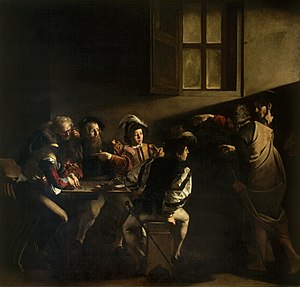
Het is vreemd hoe de schilderijen in het donker zijn geplaatst. Wat ik niet wil benadrukken is Caravaggio’s clair-obscur stijl. Nee, het is het geld. Pas nadat een Japanse toerist wat munten in de machine heeft gegooid die de verlichting regelt, kun je de schilderijen een paar minuten bekijken.
Taylor Pearson tells us in The End of Jobs. And explains how profitable this can be in today’s world.
Jobs as we know them will largely disappear. We are at the end of the Frederick Taylor work era.
Jobs are replaced by entrepreneurs. Everyone can be an entrepreneur, building a meaningful life doing what they want, now serving the long tail of markets has become profitable.